
Feminist Development is the successor to the Gender Initiative Interest Group that helped form the Sociology of Development Section of ASA.
Mission
Feminist theories have challenged development paradigms since Ester Boserup’s (1970) groundbreaking study. Despite nearly 50 years of feminist scholarship, however, many development approaches continue to sideline women, girls, and other marginalized groups. The failure to consider crosscutting power dynamics in development is obstructing intellectual growth as well as hindering the formation of more equitable development policies and practices (Bastia 2014).
Feminist Development brings together a diverse consortium of scholars and professionals who articulate and affirm feminist approaches to development, who seek more holistic understanding of the power dynamics informing development, and who support collaboration across difference. The Subsection provides a platform for exchanging information and resources on feminist development.
Leadership
We encourage you to contribute to the advancement of Feminist Development by sharing your ideas and resources with Subsection Leadership.
Co-chair, Sophia Boutilier (she/her) is an Assistant Professor of Sociology at California State University, Fresno. She began her career in international development, working on gender equality and education projects in Kenya and Ghana. Wanting to better understand the effects of burnout and cynicism she witnessed among development workers, Sophia earned a PhD in Sociology at Stony Brook University.
Her research examines how promising approaches to social change often fail to reach their potential. She unpacks the limitations and unintended consequences of policies ranging from affirmative consent to sexual contact, the promotion of Information and Communication Technologies amongst women’s groups in the Global South, to the declaration of international solidarity as a feminist development principle by a bilateral aid agency. Her work highlights the sometimes-hidden obstacles to social change shaped by privilege, misogyny, emotions, and the institutional structures of development agencies.
In her current project, Sophia is investigating the experiences of gender professionals affected by the USAID shutdown and associated executive orders effectively condemning much gender equality work.
Alongside her research and teaching, Sophia has partnered with gender equality and development organizations such as Shift: The Project to End Domestic Violence and Right to Play. In her spare time, she enjoys reading books about misogyny, singing in a choir, and seeing live music.
Co-chair, Jennifer Keahey: Jennifer is Associate Professor of Sociology in the School of Social and Behavioral Sciences at Arizona State University. Having begun her career teaching English in Japan, she has worked in seven countries and four continents. Jennifer is broadly interested in the topic of global justice. She has conducted qualitative and participatory fieldwork with small-scale farmers in Latvia and South Africa, producing numerous articles that culturally situate knowledge on local food and fair trade movements. She also has co-edited a volume on energy democracy, bringing an international body of scholars and practitioners into dialogue. Her most recent book, Decolonizing Development, engages the comparative historical cases of Latvia and South Africa to unpack agrarian change over the longue durée. While women are not always the primary focus of her work, Jennifer is passionate about bringing feminist theory and praxis into broader discourses on political economy and social change.
Secretary-Treasurer, Aarushi Bhandari is an Assistant Professor of Sociology at Davidson College. Her book Attention and Alienation: The International Political Economy of Information and Communication Technologies describes the complex evolution of the attention economic system and related forms of alienation through social media and emergent communication technologies. Her NSF: CAREER winning project “Individualized and Organizational Solutions to the Globalized Risk of Mental Illness” evaluates cosmopolitan wellness trends as they intersect with the attention economy.
Graduate Student Representative, Sarai Richter is a Ph.D. student in Sociology at Arizona State University. Their research, Khmer Feminist Ecologies: Co-Mentoring More-Than-Human Entanglements, investigates how Khmer feminist NGOs practice co-mentorship as a form of resistance to donor-driven constraints, neoliberal governance, and the nonprofit industrial complex. Drawing on PQI, socially engaged Buddhism, and posthuman-animist feminism, their work theorizes co-mentorship as feminist labor, an intra-action of entangled, affective, and more-than-human practice of care, refusal, and solidarity that reimagines world-making beyond extractive NGO logics.
They have presented their research internationally, including at the American Sociological Association, the Pacific Sociological Association, and the International Peace Research Association. Their published work includes Walking in Relation: A Cross-Cultural Theoretical and Methodological Approach (CEJ). In addition to their academic work, Sarai brings extensive experience in refugee resettlement, feminist NGO leadership, and arts-based community practice in both Cambodia and the United States.
Council Member, María Ximena Dávila Contreras (she/her) is a Ph.D. candidate in Sociology at the University of Texas at Austin. Her research examines the interplay between gender, development, violence, and the politics of care and welfare in Latin America. Her dissertation specifically asks how risk and violence become woven into the intimate domains of reproduction, motherhood, and the family. Drawing on ethnographic and historical research, she traces how domestic life, gender roles, and everyday forms of risk management are reshaped by dispossession, environmental collapse, and the aftermath of armed conflict.
María is also a human rights lawyer and has worked extensively on women’s rights in the Americas, with a focus on advancing sexual and reproductive justice.
Council Member, Rita Jalali: Rita is a Senior Scholar in Residence in the Department of Sociology and in the Center on Health, Risk and Society at American University. She received her M.A. and Ph.D in Sociology from Stanford University. Her research has focused on cross-national issues of race and ethnicity, social movements, disasters, civil society, gender inequalities, water and sanitation deprivation, and menstrual health and hygiene. Her primary field work has been in various regions of India and Turkey. She has published in numerous peer-reviewed journals. Her most recent publication, “Global Health Priorities and the Neglect of Menstrual Health and Hygiene: The Role of Issue Attributes,” was published in Sociology of Development.
Council Member, Jessica Kim: Jess is an Assistant Professor of Sociology at the University of Pittsburgh. As a political sociologist studying topics related to development and globalization, she explores the cross-national diffusion and contestation of global cultural norms to nations’ policies, practices, and opinions. In her work on gender, Jess examines the ways in which development endeavors help or hinder gender equality and women’s rights. In her published work, she explores how globally salient gender-focused institutions, organizations, and activists shape outcomes such as domestic violence legislation passage, the adoption of egalitarian attitudes, and support for women in politics. She received her Ph.D. in Sociology from Stony Brook University.
Council Member, Dr. Grace Yuehan Wang is a technology & innovation expert (with a focus on Asia-pacific), an experienced international consultant and a founder. Dr. Wang’s expertise emphasizes on artificial intelligence governance, technological innovation and digital economy in the Asia-Pacific region. Her long-term education and work experience in China, the United States, Africa and Europe & UK enables her to provide first-hand, in- depth, and multicultural analysis in regional & international development, technological innovation and global digital governance. Dr. Wang is a skilled practitioner in international education, intercultural communication and cultural diplomacy. Her book manuscript (under contract) on Shenzhen and the Greater Bay Area is one of the systematic analyses of a world-class mega city and technology hub in Asia.
Dr. Wang earned her doctoral degree from the University of Southern California in Los Angeles, and was the Annenberg Chair Fellow in Communication, Technology, and Society for two years. Previously, she studied at Boston University and the University of California, Los Angeles. She was also a visiting researcher to the Media Law and Policy program at the University of Oxford and was awarded the Frank Andrews international fellowship for the 69th Annual Summer Institute in Survey Research Techniques at the University of Michigan, Ann Arbor. Dr. Wang was the South Africa National Research Foundation grant holder during 2021-2022 and she was the only Asian recipient awarded the Joint Research Funding by Cape Higher Education Consortium / Western Cape Government (WCG) for her research proposal on digital economy in South Africa. She is a council member of the Feminist Development Council of the American Sociological Association.
Updates

Feminist Development Council Meeting, Wayne State University, October 2017
Some Feminist Development Topics
- Gender ideologies
- Women’s reproductive rights
- Female-headed households
- Intrahousehold inequalities
- Violence against women and girls
- Neoliberal economic policies
- Women’s labor force participation
- Microfinance
- Gender mainstreaming
- The whiteness of development
- Educational attainment
- Sustainable development
- Female political leadership
- CEDAW and women’s human rights
- Gender budgeting
- Migration and development
- Sexual orientation and gender identity
- Ecofeminism
- Women and technology
- Masculinity and development
- Neocolonialism
- Transnational feminism
- Intersectionality
- Participatory development
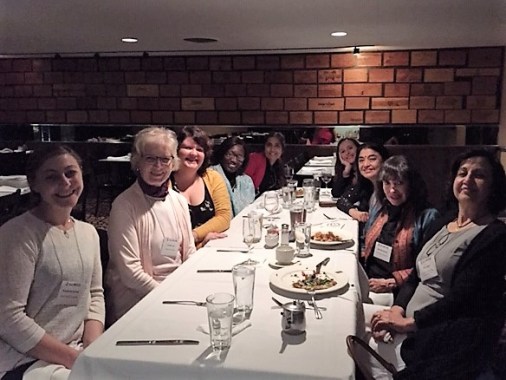
Feminist Development Dinner, University of Illinois at Urbana-Champaign, October 2018
Founding Members of Feminist Development
Rae Lesser Blumberg, University of California San Diego; Jennifer Keahey, Arizona State University; Kristy Kelly, Columbia University | Drexel University; Rebecca Kruger, Columbia University; Susan Lee, Boston University; Ann Oberhauser, Iowa State University; Farhana Sultana, Syracuse University; Yvonne Underhill-Sem, The University of Auckland; Mildred Warner, Cornell University; Barbara Wejnert, University at Buffalo

Feminist Development Subsection Formation Meeting, Cornell University, October 2016
References
Bastia, Tanja. 2014. “Intersectionality, Migration and Development.” Progress in Development Studies 14(3):237-48.
Boserup, Ester. 1970. Woman’s Role in Economic Development. London: George Allen & Unwin.
 Sociology of Development